





What are Dangerous Goods?
Dangerous Goods (Hazardous Materials)
What is “dangerous” in use vs. dangerous in transport (2026 refresh)
Dangerous goods (often called hazardous materials in the USA) can be pure chemicals, mixtures, manufactured products, or articles that may pose a risk to people, property, or the environment if they are not correctly classified, packaged, documented, handled, and transported.
A frequent operational mistake is to confuse consumer/industrial hazard labelling with transport classification. They are related—but they are not the same system, and the criteria differ.
Dangerous in use (workplace / consumer exposure)
Many everyday products can be hazardous during use (cleaning fluids, paints, gardening products, aerosols, batteries, adhesives). In most markets, hazard communication is aligned to the Globally Harmonized System (GHS), using:
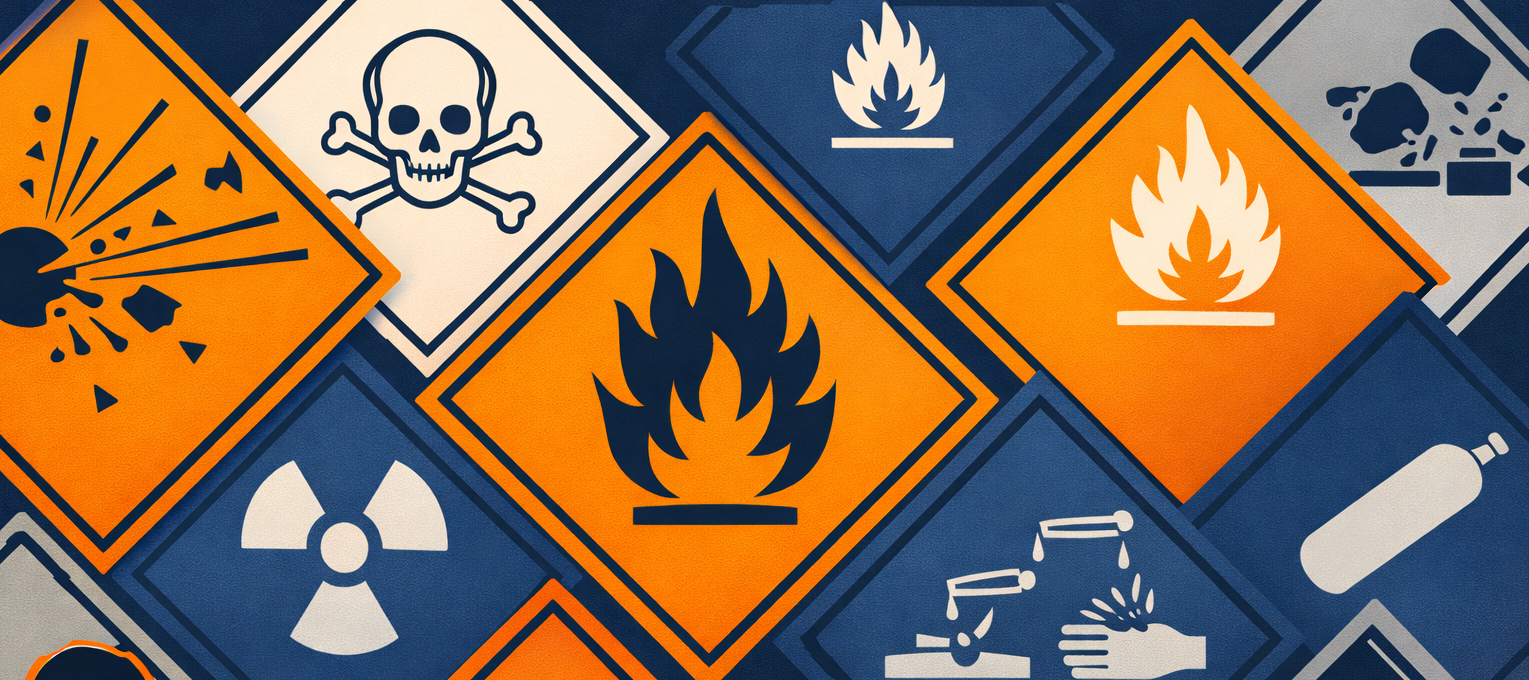
- hazard pictograms (typically red-border diamonds in the EU/EEA),
- H statements (hazard statements),
- P statements (precautionary statements),
which replaced the older R/S phrase approach in the EU framework. (echa.europa.eu)
Critical point: a hazard pictogram on retail or industrial packaging indicates hazards in use, but it does not automatically mean the product is regulated as dangerous goods for transport. Conversely, some items with limited consumer warnings may still be dangerous goods in transport (e.g., lithium batteries, aerosols, certain spare parts, vehicles/equipment containing batteries).
Dangerous in transport (logistics / carriage risk)
Dangerous goods in transport range from obvious hazards (explosives, fuming acids) to very common commodities (paints, solvents, pesticides, aerosols, lithium batteries).
Transport of dangerous goods is regulated to prevent (as far as possible) accidents involving people, property, the environment, the transport unit, and other cargo. Requirements differ by mode, but they are largely harmonized through the UN Recommendations on the Transport of Dangerous Goods (Model Regulations). (unece.org)
Mode-specific rulebooks (the operational reality)
- Road: ADR (Europe) (unece.org)
- Rail: RID (Europe; closely aligned with ADR)
- Sea: IMDG Code (International Maritime Dangerous Goods Code) (imo.org)
- Air: ICAO Technical Instructions (implemented commercially via IATA DGR) (OACI)
- Inland waterways: ADN (Europe)
2026 note (sea freight): IMDG Code Amendment 42-24 moves into mandatory application from 1 January 2026 after a transition period. If you ship DG by sea, ensure procedures and training are updated accordingly. (ttclub.com)
UN classification: 9 classes (with subdivisions)
The UN Model Regulations use a classification system where each dangerous substance or article is assigned to a Classdepending on the primary hazard:
Class 1 — Explosives
Class 2 — Gases
- Division 2.1 Flammable gas
- Division 2.2 Non-flammable, non-toxic gas
- Division 2.3 Toxic gas
Class 3 — Flammable liquids
Class 4 — Other flammables
- Division 4.1 Flammable solids
- Division 4.2 Substances liable to spontaneous combustion
- Division 4.3 Substances which, in contact with water, emit flammable gases
Class 5
- Division 5.1 Oxidizing substances
- Division 5.2 Organic peroxides
Class 6
- Division 6.1 Toxic substances
- Division 6.2 Infectious substances
Class 7 — Radioactive material
Class 8 — Corrosives
Class 9 — Miscellaneous (e.g., lithium batteries, airbags, environmentally hazardous substances that do not fit other classes)
Packing Group (PG): how dangerous is it?
While the Class defines the type of danger, the Packing Group (PG) defines the degree of danger (for many substances):
- PG I — high danger
- PG II — medium danger
- PG III — low danger
Packing Groups are written in Roman numerals to avoid confusion with Class numbers.
A substance can appear in more than one Packing Group depending on concentration. Example: a concentrated corrosive may be Class 8, PG II, while a diluted solution may remain Class 8 but be PG III due to lower severity.
What shippers must manage (business-critical, not optional)
If your product is (or may be) DG for transport, compliance is not “paperwork”—it is risk management. A robust DG shipment requires, at minimum, clear control over:
- Correct classification: UN number, Proper Shipping Name, class/division, packing group, subsidiary risks, marine pollutant status (as applicable)
- Packaging compliance: UN-approved packaging where required, correct closures, segregation rules, quantity limits (e.g., limited quantities)
- Marking & labelling: correct transport labels/marks (not just workplace hazard pictograms)
- Documentation: DG declaration where required + supporting data (e.g., SDS)
- Training & competency: staff and vendors who touch DG must be trained to the applicable mode rulebook (air is typically the strictest) (OACI)
Practical checklist
Before shipping, confirm in writing:
- Is the product DG in transport (not only “hazardous in use”)?
- What is the correct UN classification (UN number + Proper Shipping Name + Class + PG)?
- Which mode rulebook applies (ADR / IMDG / ICAO-TI, etc.) and who owns compliance?
- Are packaging, marks/labels, and segregation rules validated (including consolidation and container packing)?
- Are documents complete (DG declaration where applicable) and consistent with booking and commercial docs?
- Do carriers/forwarders have current DG acceptance rules and trained staff for the lane?
- Do you have an exception process (rework, re-label, quarantine, rejection costs, liability)?
Bottom line: DG compliance is a supply chain capability. Done well, it prevents incidents, protects people and assets, avoids shipment rejections and fines, and reduces insurance and liability exposure.

