


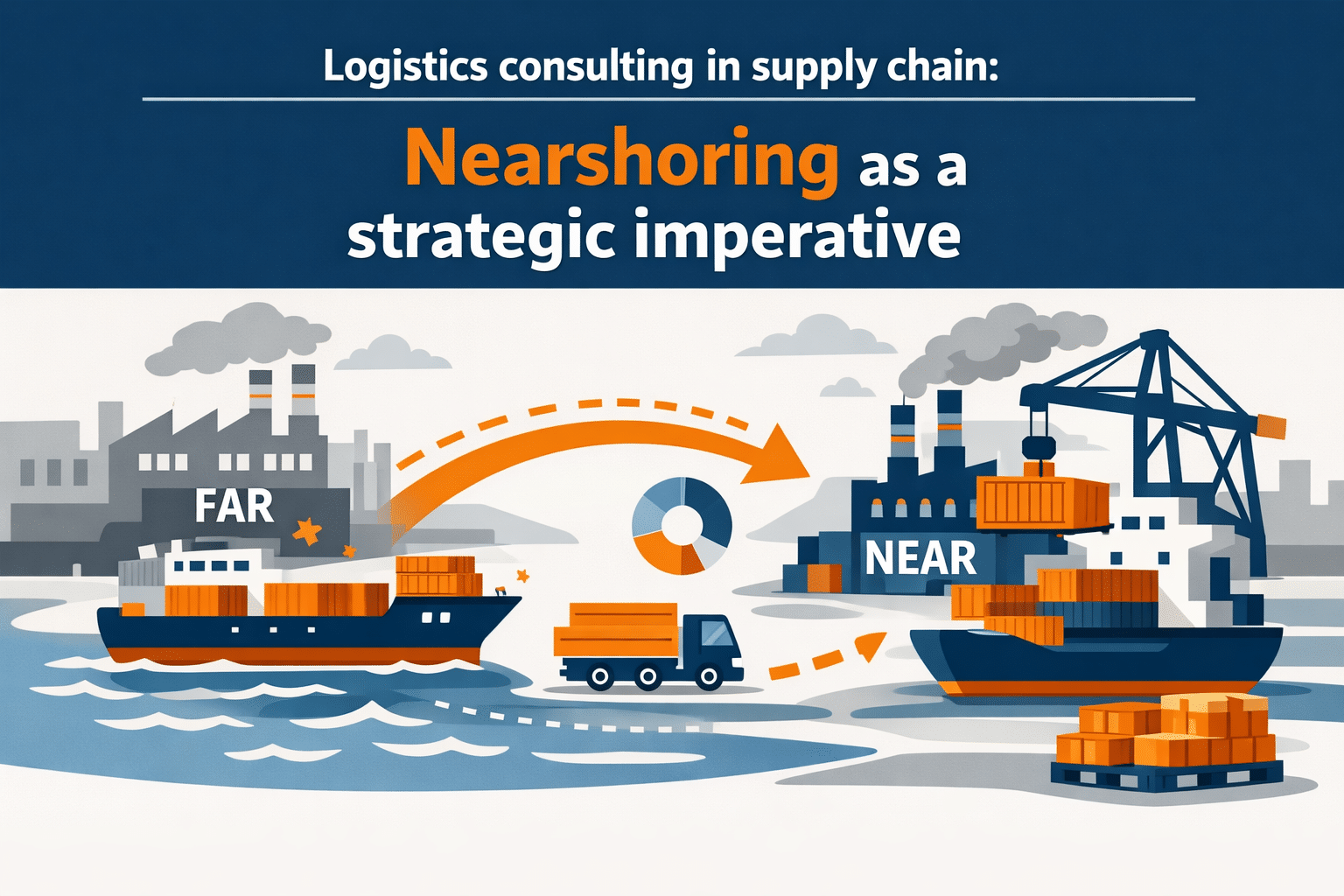
Logistics consulting in supply chain: Nearshoring as a strategic imperative
Global freight costs have risen by more than 30% in recent years while disruptions appear in supply networks with increasing frequency. Yet many logistics footprints still rely on offshore assumptions that no longer match current operating conditions. As COOs and supply chain leaders face pressure to reduce exposure and manage cost without weakening service, nearshoring has shifted from a tactical sourcing option to a structural decision about where to locate production and how to manage flows. This article outlines how logistics consulting helps turn nearshoring into a quantified strategy that connects network redesign, total cost of ownership, resilience and digital capabilities with operational and financial outcomes.
Decision framework for nearshoring: TCO, lead time, resilience and multi tier supplier visibility
Nearshoring has become a strategic priority for many organizations, yet decision making often lacks a rigorous framework. Bain & Company reports that 80% of COOs intend to expand nearshoring or onshoring within three years, while only 2% have fully implemented such strategies. This ambition execution gap reinforces the need for structured assessments of total cost of ownership, lead times, resilience and supplier transparency.
We recommend evaluating nearshoring as a set of scenarios rather than a single shift. Each scenario should quantify trade offs between higher labor or setup costs and potential gross margin improvements, building on the findings highlighted by Bain. Linking these economics to service performance, risk exposure and capital intensity enables comparisons on consistent criteria.
- Define target service levels and acceptable lead time ranges by product family
- Map end to end cost drivers, including ramp up, dual running and exit costs
- Quantify risk exposure from geopolitical, logistics and supplier disruptions
- Assess regulatory, tax and labor constraints in candidate nearshore locations
- Evaluate digital readiness and automation potential at sites and partners
Total cost of ownership extends far beyond unit manufacturing costs. We include transportation, duties, inventory holding, quality, obsolescence, shortages and delivery delays. Modeling approaches that incorporate lead time variability and capacity constraints show how these factors interact, helping you identify when regionalization becomes more competitive than traditional offshoring.
Lead time performance is often a visible benefit of relocating production closer to demand. Shorter and more predictable transit supports smaller batches, lower safety stocks and faster reaction to demand shifts. However, if critical components still move across long distances, effective lead time may not change. This is why we evaluate lead time across the entire bill of materials and model the effects of split shoring and regional diversification.
Resilience increasingly shapes network redesign. Bain analysis shows that supply continuity and risk mitigation now influence decisions more than cost arbitrage. Meanwhile, AI driven risk monitoring has improved the speed and accuracy of detecting disruptions across extended networks. Integrating such tools enables comparisons of nearshoring options not only on expected cost, but also on their capacity to absorb and recover from shocks.
Multi tier supplier visibility remains limited in many nearshoring programs. Most companies understand Tier 1 exposure but lack transparency on Tier 2 and Tier 3 dependencies. Recent analysis on nearshoring strategies shows that relocating assembly while retaining deep tier vulnerabilities restricts the benefits. We therefore promote transparency roadmaps that combine contractual requirements, data sharing and digital monitoring across relevant tiers.
Digital tools are expanding the possibilities in this area. AI based disruption monitoring, IoT tracking and supplier data platforms improve visibility and support proactive risk management. These capabilities allow companies to simulate how disruptions at sub suppliers propagate through the network and how different nearshoring configurations respond, supporting informed trade offs between cost, service and resilience.
Regulatory and compliance factors must be incorporated early. Recent nearshoring case studies highlight delays when companies underestimated labor, tax or permitting conditions. We integrate a regulatory checklist into the decision model, scoring each candidate location on complexity and predictability and linking these scores to risk adjusted TCO and implementation timelines.
To operationalize this framework, we align operations, procurement, finance and tax around a common fact base. Scenario outputs are consolidated into a shortlist of options, each with quantified TCO, lead time performance, resilience index and multi tier visibility score. This enables organizations to move from broad intent to a practical roadmap of nearshoring steps with clear ownership.
Logistics consulting playbook: network redesign, inventory strategy, transport optimization and digital enablement
Nearshoring is reshaping network design. Instead of relying on a single offshore hub, companies increasingly need regional architectures that balance cost, risk and service. Bain & Company notes that while most COOs plan to expand nearshoring, only a small minority have executed, illustrating the operational demands associated with reconfiguring networks.
We typically begin with a clean sheet network model. Plants, suppliers, distribution centers and customer locations are mapped, and scenarios such as split shoring or regional diversification are simulated. This allows comparison between consolidating operations in a nearshore hub or distributing production across several smaller regional facilities.
Inventory strategy must evolve alongside network redesign. Nearshoring reduces lead times but introduces new risks through ramp up phases and deep tier dependencies. We redesign safety stocks, decoupling points and postponement strategies so that inventory buffers reflect updated flow patterns.
AI and machine learning strengthen this work. Industry research shows that AI tools can reduce inventory and logistics costs while supporting service reliability. We use these technologies to refine forecasting, identify volatility earlier and position stock dynamically across nearshore and onshore locations.
Transport optimization in a nearshored network requires adjustments beyond shorter distances. Modal mix, cross border routing and carrier portfolios must adapt. We support the redesign of lane structures, negotiation of new contracts and evaluation of intermodal corridors that connect nearshore manufacturing clusters with main consumption markets.
Digital twins play a growing role in route design and capacity planning. By combining AI based path optimization with real time data, companies can evaluate the effects of congestion, regulatory shifts or capacity constraints. This supports decisions such as adding regional cross docks, switching modes or adjusting routings to maintain service continuity.
Digital enablement is the foundation of these transformations. IoT devices provide continuous visibility on shipments and assets, supporting control towers that monitor flows across nearshore, onshore and offshore nodes. Industry sources show how IoT adoption improves asset utilization and on time performance through real time condition and location data.
Within warehouses and nearshore distribution centers, augmented reality tools support more accurate picking and faster training. Research indicates performance gains around 25% in AR supported environments. We integrate these solutions into process design to improve productivity and accuracy during the early phases of establishing new regional hubs.
- Redesign networks around regional hubs and split shoring options
- Rebuild inventory policies using AI enhanced forecasting and segmentation
- Optimize transport lanes, modes and carrier strategies for nearshore flows
- Deploy IoT for visibility across multi tier supplier networks
- Use AR and automation to support ramp up in regional facilities
- Create digital twins to test scenarios before committing capital
- Align procurement, operations and finance around the new network
Recent analysis on nearshoring stresses that relocation is a long term competitiveness decision rather than a short term cost initiative. With meaningful margin improvement possible for companies that execute nearshoring effectively, a structured consulting playbook across network redesign, inventory, transport and digital enablement becomes a key lever for performance.
Execute and measure: pilot design, ROI sensitivity, regulatory checklist and selecting a logistics consulting partner
Nearshoring has become a strategic priority, yet Bain & Company reports that only 2% of firms have fully implemented related strategies. At the same time, 80% of COOs plan to accelerate nearshoring within three years. This gap highlights the need for disciplined pilots, ROI clarity and strong governance before committing to scale.
Pilot design begins with defining customer outcomes and risk reductions. These translate into measurable KPIs across service, cost, resilience and sustainability. Leading practices emphasize early assessment of customer needs and supply chain risks, supported by automation and AI where they can enhance agility, such as scenario simulations or dynamic safety stock models.
Bain analysis notes that companies may achieve significant gross margin gains from well executed nearshoring programs, but only after upfront investment in sites and ramp ups. We therefore structure pilots to validate value early, using phased volumes and limited product scopes. This allows testing of assumptions on labor productivity, yield, logistics savings and working capital before full relocation.
To compare nearshore locations and supplier options, we apply standardized frameworks with weighted scoring. These typically assess cost competitiveness, quality assurance, reliability, technical capability, sustainability, compliance, innovation and scalability. The result is a transparent comparison aligned with your strategic priorities.
Given the sensitivity of nearshoring business cases to shifts in demand, wages or tariffs, we conduct ROI sensitivity analyses for each pilot. We stress test scenarios such as volume volatility, transport cost fluctuations or ramp up delays. This reflects how companies increasingly use AI to simulate nearshoring scenarios and evaluate sourcing alternatives.
| Scenario | Key driver tested | Impact focus |
|---|---|---|
| Base case | Planned demand & wage levels | Expected payback period |
| Downside | Lower volumes, higher labor costs | Minimum acceptable ROI |
| Upside | Faster ramp up, better yields | Potential margin expansion |
Regulatory complexity frequently slows execution. We therefore embed compliance by design into the pilot. Working with legal, tax and HR teams, we build a regulatory checklist covering customs regimes, trade agreements, labor rules, environmental standards, data protection and sector specific certifications.
- Map applicable trade and customs regimes, including preferential agreements
- Screen labor, health and safety and union regulations
- Assess tax incentives, permanent establishment considerations and transfer pricing rules
- Review environmental and product compliance requirements
- Define data protection and cybersecurity controls
- Set governance and documentation to accelerate approvals
Because many companies lack visibility beyond Tier 1 suppliers, we integrate multi tier transparency into pilot scope. We identify critical Tier 2 and Tier 3 components, map geographic concentration risks and deploy IoT or platform based tracking where feasible. Without this, relocating assembly can leave deep tier vulnerabilities unaddressed.
To move efficiently from pilot to deployment, we implement governance structures that clarify decision rights and escalation paths. Weighted scoring frameworks support fact based go or no go decisions. Embedding compliance by design and strong governance helps shorten the time between a successful pilot and scaled execution.
Selecting the right consulting partner is central to closing the ambition execution gap. Ideal partners combine expertise in nearshoring strategy, freight procurement, warehousing and trade compliance, and can work cross functionally with operations, finance, legal and HR. Experience with AI driven scenario modeling and building regional supply ecosystems is increasingly relevant.
We recommend evaluating partners using a structured scorecard similar to supplier assessments. Criteria can include pilot design methodology, capability in ROI sensitivity analysis, regulatory experience in target regions, digital toolsets for multi tier visibility and the ability to transfer knowledge to internal teams. This ensures that your partner supports both execution and long term capability building.

