



Supply Chain Management — The Impacts of the Iran Attack on Supply Chains and Global Business
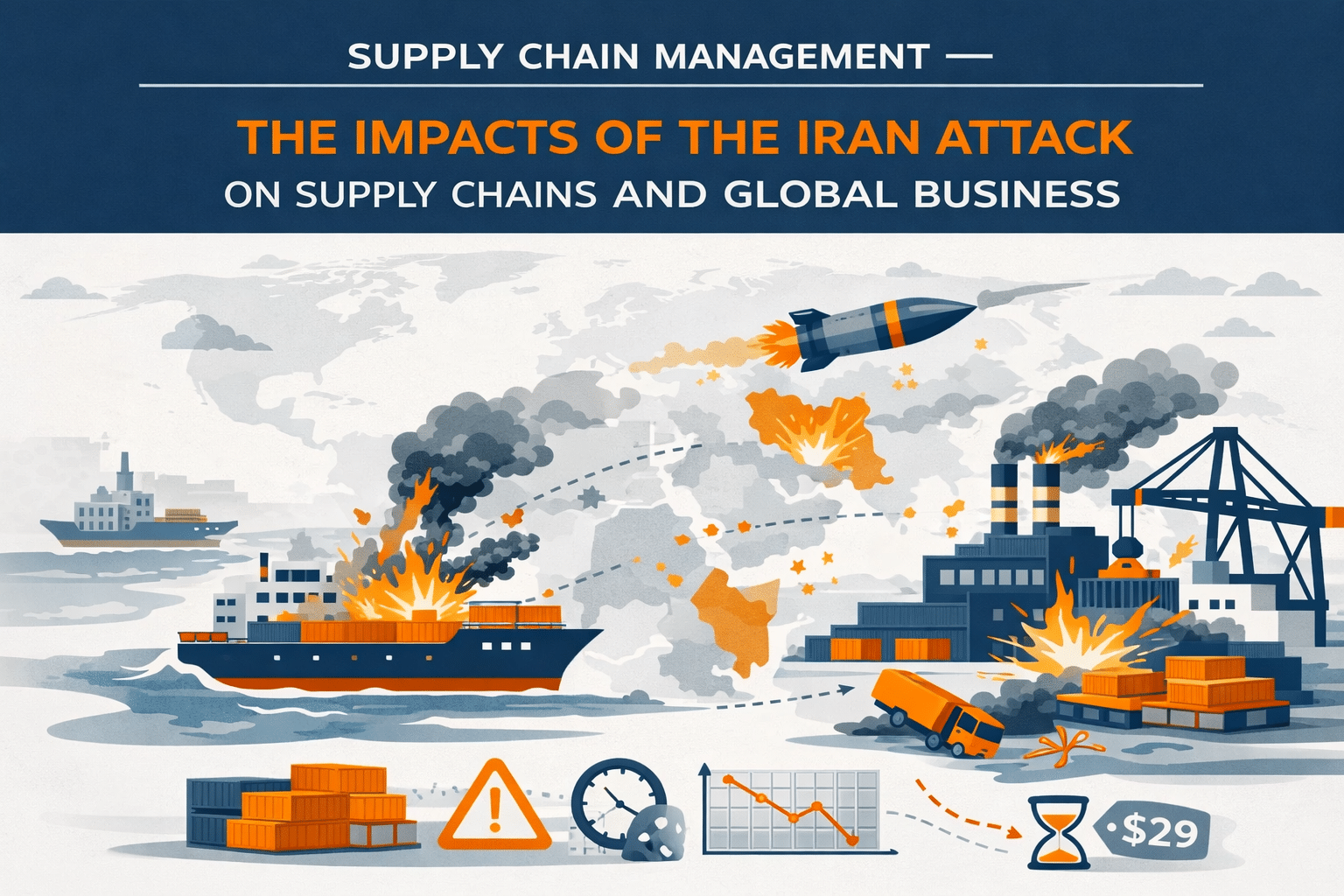
Oil prices rising + 100$, tanker traffic through the Strait of Hormuz dropping by around 97% and thousands of flights rerouted or grounded are not headlines for you, they are immediate operational variables. As a supply chain or operations leader, this Iran attack shock must be translated into decisions on routing, cost exposure, inventory levels and service performance across your network. The sections below outline how these disruptions affect your P&L, your customer commitments and your working capital, and which actions to prioritise with procurement, logistics and finance.
Immediate operational impacts: routing constraints, cost pressure and service degradation
The Iran attack and the resulting geopolitical tensions are already influencing day-to-day operations. You face rapid changes in routing options, freight rates, capacity availability and transit time predictability across maritime, air and multimodal flows.
The reduced accessibility of the Strait of Hormuz, which normally handles close to one fifth of global daily oil flows, has led to a significant decline in maritime traffic. Tanker movements have dropped sharply, prompting carriers and shippers to reroute or suspend services. This is affecting sailing schedules, equipment repositioning and reliability on trade lanes connected to the Gulf.
Oil prices have moved quickly, increasing by up to +100$ to per barrel. This leads to higher bunker costs, fuel surcharges and conflict-related add-ons on freight invoices. Logistics providers have begun applying risk surcharges, and further adjustments are likely as insurance and security assessments evolve.
- Rerouting of vessels around high-risk zones, extending transit times
- War and risk surcharges added to ocean and air freight invoices
- Lower schedule reliability and more blank sailings
- Flight diversions and cancellations due to restricted Gulf airspace
- Inventory strain in time sensitive sectors
- Higher working capital requirements to manage variability
Air transport is also constrained. Airspace closures across the Gulf have led to grounded or redirected flights. Longer flight paths and reduced belly capacity are tightening available uplift, especially on corridors that rely on Gulf hubs. This is driving rate increases for urgent shipments.
These combined route disruptions are amplifying rate volatility. Ocean spot markets on affected corridors reflect capacity withdrawals and rising risk premiums. On the air side, emergency bookings and unplanned diversions are pushing prices up on lanes previously served by Gulf carriers.
Inventory management is becoming more complex. Lead times are lengthening and predictability is decreasing, challenging traditional safety stock models. Industries such as pharmaceuticals, electronics and oil derived goods are reporting delays and irregular arrival patterns for critical components.
Service performance is under pressure. Reconfigured networks, longer transit times and congestion at alternative ports and airports increase the likelihood of late deliveries. Line-item shortages, partial shipments and mode changes are becoming more common and add complexity for planning teams.
Ground operations at alternative gateways are experiencing volume surges, creating bottlenecks in trucking and terminal handling. This is driving queuing, slower turnaround times and higher inland transport costs, particularly in regions receiving diverted cargo.
Financial exposure is rising as higher freight rates, fuel-linked adjustments and longer cash-to-cash cycles affect logistics budgets. Landed cost calculations and margin assumptions need to be revisited, along with contract clauses defining responsibilities in case of war related disruptions.
What current coverage highlights and where supply chain leaders need deeper insight
A review of current search results on the Iran attack shows content primarily focused on geopolitics, security responses and broad trade risks. Detailed implications for freight flows, routing decisions and contractual exposure remain limited.
Energy markets, insurance premiums and airspace closures feature prominently in coverage, but operational impacts on specific lanes or modes are rarely quantified. References to rerouting or higher freight rates tend to remain high level, with limited guidance on measurable effects on transit times or landed cost.
Most articles are short news updates or opinion pieces. Few provide structured analysis connecting the Iran attack to supply chain design, sourcing strategies or service level risk. Scenario planning, supplier diversification and governance approaches are mentioned but seldom translated into actionable frameworks.
The Iran attack is often treated in isolation, without linking it to ongoing Red Sea disruptions, port congestion or container imbalances. This gives a fragmented view and makes it harder to assess cumulative risk on inventory, working capital and customer commitments.
Practical guidance on next steps for procurement, logistics and finance is limited. Clear actions such as adjusting safety stocks, renegotiating surcharges or rebalancing carrier portfolios rarely appear in a structured format.
Data-driven insights also remain scarce. Many articles cite expert opinions but provide few assumptions or ranges useful for internal planning. Lane-specific and sector-specific indicators are generally missing.
Digital capabilities such as predictive ETAs, risk scoring or control tower coordination are briefly referenced but not explored in depth. The role of TMS data or collaborative platforms in managing disruptions is largely absent from SERP results.
There is also limited guidance on internal communication. Boards, customers and regulators are requesting clarity on exposure to the Iran events, yet few articles support leaders with metrics or reporting templates to structure these conversations.
Mitigation priorities for procurement, logistics and executive teams
The Iran attack has changed the risk profile of key corridors and revealed dependencies in many networks. Treating this as a structured stress test helps align procurement, logistics and finance on coordinated responses.
Scenario planning: defining assumptions and trigger points
We recommend using three planning horizons: short-term disruption, medium-term instability and potential long-term changes to trade patterns. Each horizon should include assumptions on transit times, capacity, insurance conditions and regulatory responses to support consistent decision making.
- Short-term: localized delays, temporary rerouting, volatile spot rates
- Medium-term: sustained congestion, network adjustments by carriers, contract revisions
- Long-term: shifts in sourcing locations and modal mix
- Trigger points for moving between scenarios
- Named owners for each scenario and region
Procurement: securing supply and reducing exposure
Procurement teams should focus on ensuring supply continuity while maintaining flexibility. Contract reviews are essential to understand force majeure clauses, routing options and surcharge mechanisms. Supplier mapping helps identify dependencies on affected corridors.
- Segment suppliers by criticality and exposure
- Negotiate temporary routing options and alternative ports
- Shift part of volume to longer-term contracts with flexible lanes
- Define risk sharing structures for war premiums and emergency fees
- Pre-qualify alternative suppliers in lower-risk regions
Logistics: routing strategies and inventory adjustments
Rapid simulations can help compare alternative routings and translate outcomes into clear instructions for carriers and forwarders. Inventory buffers may need to be recalibrated to account for longer and less predictable lead times.
- Map flows touching exposed corridors across modes
- Define preferred and fallback routing options by lane
- Increase safety stocks for high-margin or long-lead items
- Use cross-docks and regional hubs to manage upstream and downstream variability
- Align booking windows and cut-off times with updated transit assumptions
Executive actions: governance, capital and communication
Executives should establish a governance structure that links operational choices with financial outcomes. Clear communication with customers, investors and employees helps manage expectations during adjustments.
- Define decision rights for rerouting and mode shifts
- Set temporary limits for logistics cost relative to sales
- Allocate budget for emergency freight and strategic inventory
- Prioritise investments in visibility and control tower tools
- Coordinate external messaging on service and lead times
KPIs and monitoring: enabling timely action
A focused KPI set linked to the Iran attack supports faster reaction. Moving from monthly reports to dynamic monitoring helps prevent disruptions from translating into missed orders or cost overruns.
- Lead time adherence by corridor and mode
- Logistics cost per unit and per lane, including surcharges
- War risk premiums as a percentage of freight spend
- On-time in-full performance for exposed segments
- Inventory days on hand for critical items
- Share of volume routed through alternatives
Next steps: a 30, 60 and 90-day roadmap
A structured 90 day plan supports coordinated execution. In the first month, focus on visibility and customer alignment. Over the following months, embed scenario based decisions into contracts, network design and budgeting. Insights from the global supply chain risk report can support prioritization.
- 30 days: risk mapping, rerouting adjustments, customer updates
- 60 days: contract revisions, inventory policy review, KPI refinement
- 90 days: structural network redesign, sourcing diversification, governance updates

