


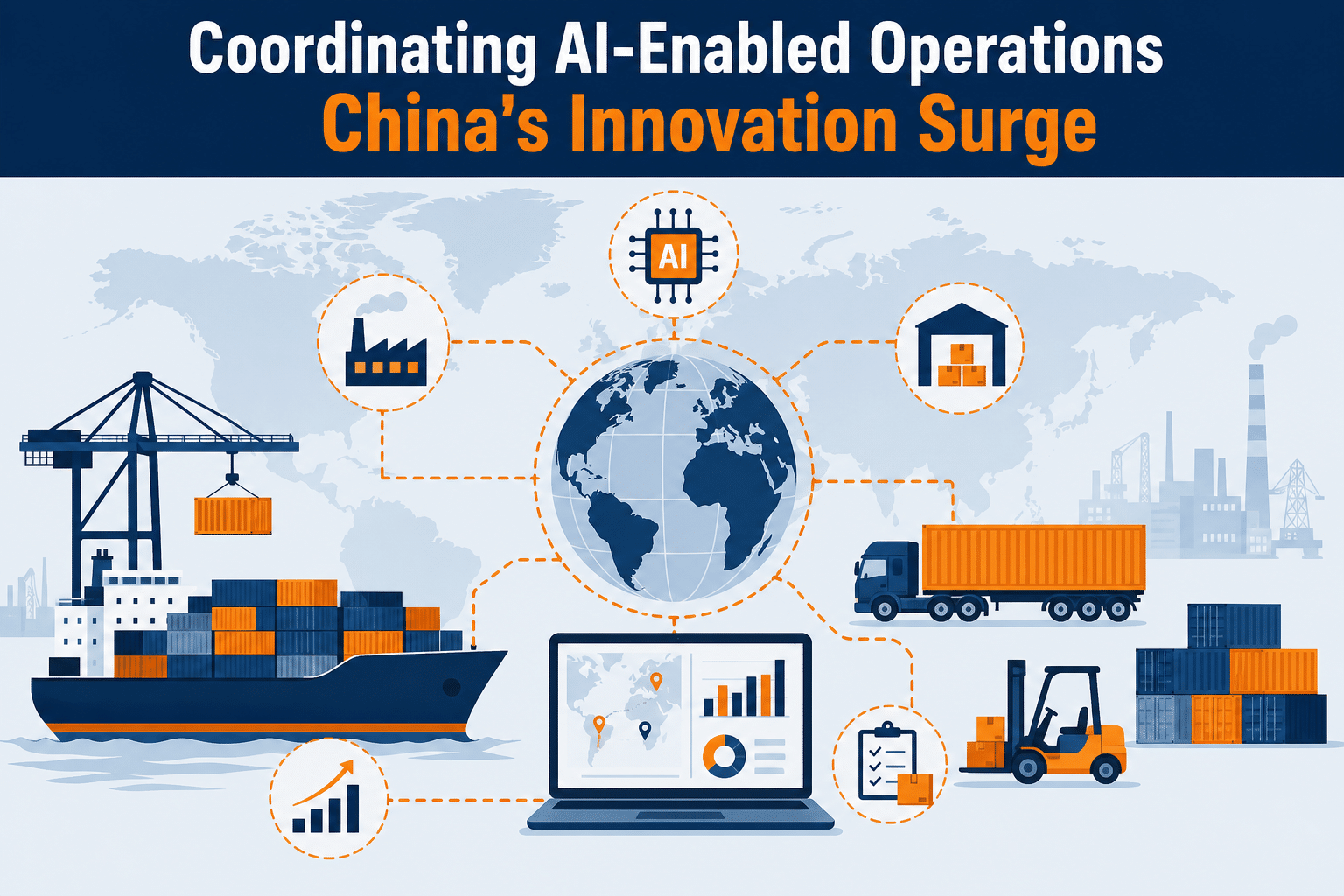
Coordinating AI-Enabled Supply Chain Operations — Impact of China’s Innovation Surge
Shenzhen robotics firms can reportedly source 90% of components nearby, while the city counts more than 74,000 robotics related enterprises.
For your supply chain, this signals a shift from isolated AI pilots to coordinated operations across suppliers, plants, warehouses, transport modes and export channels.
At Logistics Concepts, we assess how China’s innovation surge affects AI enabled supply chain coordination, from real time visibility and digital twins to ERP, WMS, TMS and OMS integration.
We focus on what you need to measure: resilience, cost control, compliance, traceability, service levels and governance of data and models.
China’s system level drivers and global trends shaping AI enabled supply chain coordination
AI enabled supply chain coordination is shaped by China’s capacity to connect R&D, financing, patents, component supply, manufacturing and export channels. Canton Fair reporting from 18 May 2026 points to robotics and AI moving from prototypes to commercial pilots and deployed use cases.
China’s “0 to 1”, “1 to 100” and “100 to 10,000” model links breakthrough innovation, industrialization and global reach. For an AI driven supply chain, we see faster orchestration, stronger visibility and broader cross border deployment. We also assess exposure to AI supply chain risks before scaling.
| System driver | Reported evidence | Supply chain signal |
|---|---|---|
| Industrial clusters | Shenzhen robotics firms can reportedly source 90% of components nearby, with more than 74,000 robotics related enterprises. | Shorter lead times, lower coordination costs and faster product iteration. |
| Regional manufacturing depth | Anhui can reportedly source nearly all parts for new energy vehicles within a three hour drive. | Supports network design, inventory planning and multi site synchronization. |
| AI infrastructure | Chinese AI models are being adapted to run on domestic processors, including Huawei Ascend. | Connects chips, computing power, energy supply and MLOps for supply chain use cases. |
| Open ecosystems | China is a large contributor to open source software and model releases. | Can support interoperability for digital twins, control towers and platform orchestration. |
For AI enabled operations, the signal is clear. Supplier orchestration, control tower design, demand sensing and risk management depend on ecosystem density, not software alone. Global scaling also requires after sales support, market access, customs integration and data governance.
Operational architecture for AI driven supply chain workflows
For coordinating AI enabled supply chain operations, we structure workflows around shared data, event triggers and governed models. China’s 2026 innovation pattern shows how robotics can move from R&D to field use when finance, patents, suppliers and users are connected.
The same logic applies to an AI enabled supply chain. Shenzhen’s robotics cluster can reportedly source 90% of components nearby, while Anhui can source nearly all NEV parts within a three hour drive. Your architecture must convert proximity, data and capacity into faster decisions.
| Architecture layer | Practice | Workflow impact |
|---|---|---|
| Data foundation | Use data fabric, GS1 identifiers, IoT sensors, RFID, GPS, telematics and WCO data model alignment. | Supports traceability, visibility, customs digitalization and carbon footprint tracking. |
| Integration | Connect ERP, WMS, TMS and OMS through APIs, event based architecture and microservices orchestration. | Enables orchestration, dynamic routing, automatic replenishment and exception alerts. |
| Decision layer | Build a digital twin for demand sensing, lead time prediction, Monte Carlo scenarios and prescriptive analytics. | Improves forecasting, inventory planning, dynamic safety stock and contingency planning. |
| Model governance | Apply MLOps for supply chain, explainability, drift monitoring, OT/IT cybersecurity and data localization controls. | Reduces operational risk across suppliers, warehouses, ports, transport networks and cross border workflows. |
How to evaluate Chinese AI supply chain solutions: performance, risks, compliance and ROI
Evaluate Chinese AI enabled supply chain solutions on measured operational gains, not on technology claims. The Canton Fair reporting from 18 May 2026 shows how coordinated ecosystems can move robotics and AI from R&D to deployment. You still need proof by use case.
| Evaluation area | What to verify | Relevant KPIs |
|---|---|---|
| Performance | Fit with orchestration, visibility, demand forecasting, inventory planning and dynamic replenishment. | OTIF, fill rate, lead time, inventory turnover |
| Architecture | API integration with ERP, WMS, TMS and OMS, event based architecture, MLOps and drift monitoring. | Integration time, alert accuracy, uptime |
| Risk | Supplier concentration, semiconductor exposure, OT/IT cybersecurity and continuity planning. | Recovery time, supplier dependency, incident rate |
| Compliance | Data localization, PIPL, China Data Security Law, export controls, customs digitalization and traceability standards. | Audit findings, data residency, clearance time |
| ROI | Cost to serve reduction, labor productivity, freight cost control and carbon footprint tracking. | Payback period, cost per order, CO₂ per shipment |
We also test whether a digital supply chain control tower can support an AI driven supply chain across regions. This includes digital twin simulation, lead time prediction, anomaly detection, scenarios and contingency planning.
China’s dense clusters, such as Shenzhen’s reported 90% local component sourcing and more than 74,000 robotics related enterprises, can reduce lead times. Your ROI model should still include after sales support, interoperability, international trade compliance and supply chain risk management.


