



Navigating the Unique Security Risks of Asia’s Digital Supply Chain
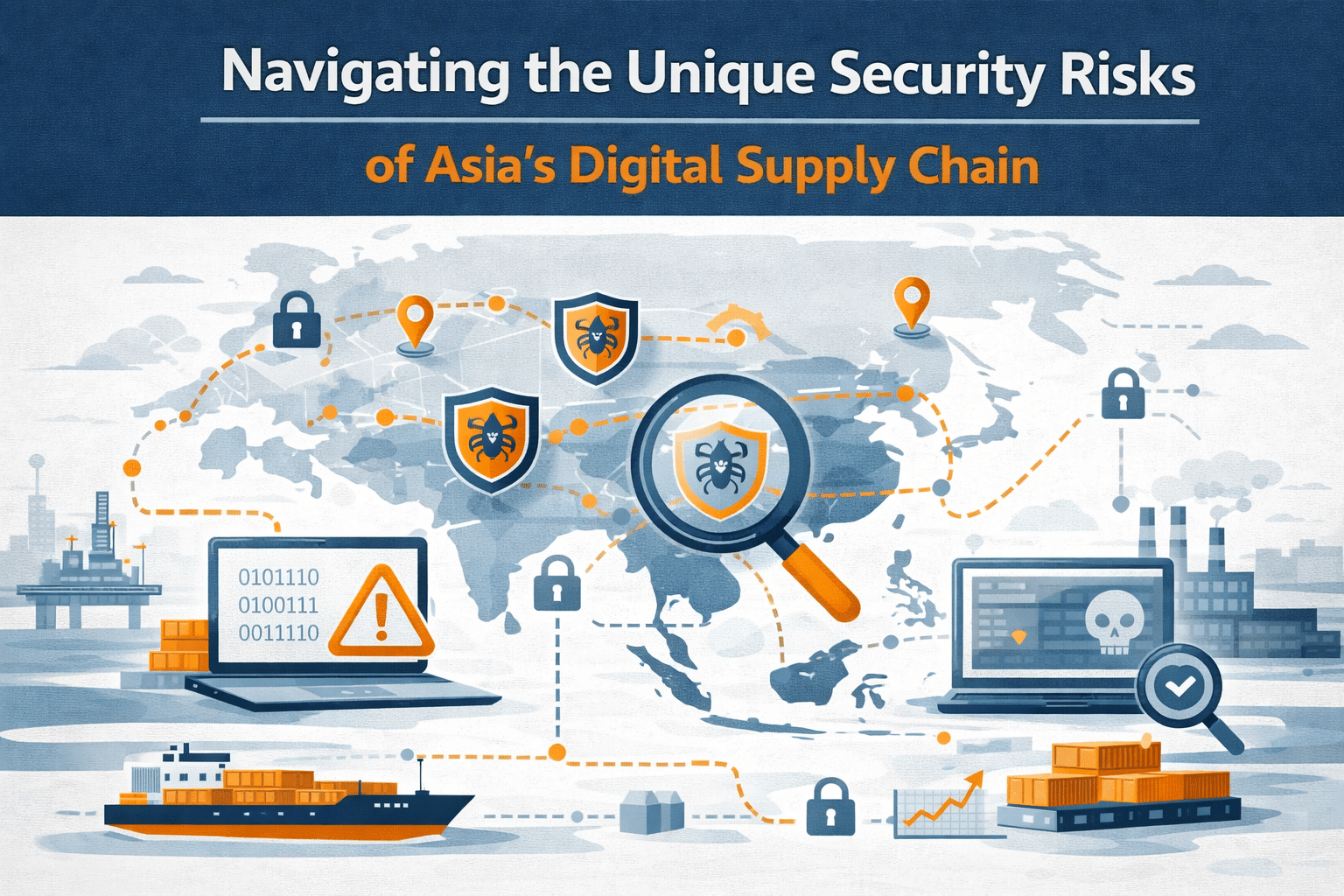
Asia’s digital supply chain is now so tightly connected that a weak vendor link in Vietnam, India, or China can disrupt operations in Singapore or Hong Kong with little warning. As regional regulations, nation state activity, and AI powered platforms evolve, logistics leaders must keep freight moving while ensuring that every system, partner, and data flow remains secure and compliant. This article outlines who is targeting Asia’s digital supply chains, where the main vulnerabilities appear, and which actions should be prioritized to protect cross border operations and financial performance.
Asia’s risk profile and regulatory map: cross border, nation state, and AI supply chain threats
Asia’s digital supply chain combines tight technical interconnectivity with fragmented regulation. Ecosystems that link Singapore, Indonesia, Malaysia, Thailand, the Philippines, Vietnam, India, and China operate with different supervisory standards and levels of cybersecurity maturity. For logistics leaders, this creates exposure that traditional governance and procurement models struggle to manage.
Core logistics platforms, freight marketplaces, customs brokers, and data providers are often sourced from multiple Asian jurisdictions. Each vendor brings its own compliance posture and technology stack. When onboarding a transport management system, warehouse automation tool, or AI forecasting engine, visibility into code origin, cloud regions, and sub processors is frequently limited.
This opacity creates operational vulnerability. A business headquartered in Singapore may rely on a route optimization platform from Vietnam, a customs data provider from India, and a warehouse control system from China. Each operates under different privacy rules, data residency requirements, and security obligations that must align with internal standards.
Complexity increases when development, hosting, and AI components span multiple countries. A product built in Singapore, powered by a Chinese AI model, and serving US customers faces overlapping regulatory regimes. Comparable patterns appear in logistics tools coded in India, trained on European datasets, and relying on AI engines maintained in mainland China.
These structures make it difficult to assess vendor maturity at onboarding. Research cited by Securitybrief.asia notes that 86 percent of organizations have installed third party code packages containing high severity vulnerabilities. In logistics, this could affect transport planning modules, port community integrations, or warehouse robotics controllers, creating potential points of disruption.
Asia’s threat landscape compounds this risk. Nation state activity is a recurring feature, with Singaporean organizations frequently targeted. The Bank Indonesia breach linked to Conti ransomware illustrates how regional financial and infrastructure systems can be compromised. For logistics networks dependent on banking interfaces, trade finance platforms, or payment systems, such incidents can lead to shipment delays, demurrage, and service degradation.
Attack economics continue to shift. The cost of exploiting weaknesses is decreasing, and the number of integration points in digital supply chains is rising. For freight forwarders, carriers, and 3PLs, APIs for booking, tracking, and customs clearance present accessible entry points that can be probed at scale.
AI adoption accelerates these dynamics. Large language models and other AI systems depend on extensive third party integrations to support document parsing, rate benchmarking, predictive ETAs, and inventory planning. This interconnected AI supply chain expands the attack surface beyond what legacy vendor risk programs were designed to address.
Securitybrief.asia observes that rapid AI adoption and diverse regulatory environments are reshaping digital risk in Asia. At the same time, geopolitical concerns continue to influence scrutiny of AI development and cross border technology partnerships. For logistics networks managing controlled commodities or sensitive trade lanes, understanding where AI models are developed and maintained becomes strategically important.
The upcoming Black Hat Asia 2026 session, “Securing the Supply Chain: Managing Third Party Risk in Asia’s Hyper Connected Digital Ecosystem,” reflects these concerns. Experts from Bitdefender, ISACA, Varonis, Sparkle AI, and others will examine real world compromises and emerging attack patterns, emphasizing the need for updated risk management approaches tailored to AI driven supply chains.
Darkreading.com highlights a three layer security approach relevant for logistics operations. First, organizations must map all vendors, including niche software suppliers, integration partners, and AI model providers. Second, continuous monitoring is needed to detect anomalies in booking portals, EDI gateways, or warehouse systems. Third, internal AI systems must be validated and governed to prevent manipulation of routing, pricing, or risk scoring algorithms.
Given Asia’s fragmented regulation and accelerated AI usage, logistics decision makers need more rigorous vendor risk management and cross border compliance frameworks. Digital partners are enablers of efficiency, but they also introduce potential vectors for nation state activity, ransomware, and AI driven exploitation.
Prioritized controls and an operational playbook for Asia focused digital supply chains
Asia’s digital supply chains operate across jurisdictions with different regulatory and security expectations. Traditional checklist based vendor programs are increasingly misaligned with AI driven integrations and shifting attack patterns. A structured operational playbook helps logistics organizations address these challenges.
The Dark Reading analysis of Black Hat Asia 2026 shows how third party tools, AI models, cloud platforms, and automation systems form a tightly connected digital fabric. We translate these insights into a three layer control framework that can be embedded into logistics operations.
Layer 1: Vendor discovery, mapping, and segmentation
The first task is to identify and map all vendors that connect to your business. This includes IT suppliers, freight forwarders, 4PL partners, customs brokers, visibility platforms, warehouse systems, and AI planning tools. A clear map is essential for managing exposure across Asia’s diverse regulatory landscape.
- Build a single registry of all third parties, including sub processors and AI model providers
- Tag vendors by country exposure, data access level, and operational role
- Classify vendors by criticality to transport, warehousing, and customer services
- Document embedded AI capabilities and automation features
- Ensure procurement workflows require vendor registration before onboarding
With visibility in place, segment connectivity and data flows. Vendors operating in higher risk jurisdictions or handling sensitive shipment, financial, or customs data should operate within restrictive network zones. This aligns with Dark Reading insights on vendor maturity and product composition across the region.
Layer 2: Observability, monitoring, and incident ready operations
The second layer focuses on detecting issues quickly once vendors are integrated. Asia’s connected AI ecosystem requires continuous supervision rather than periodic assessments.
- Instrument APIs, EDI links, and data feeds with performance and security logging
- Correlate events from transport management, warehouse systems, and cloud platforms
- Define alerts for abnormal data volumes, unexpected access, or unusual AI model activity
- Rehearse incident runbooks to isolate compromised vendors while keeping freight moving
- Ensure incident notification processes align with regional expectations
Nation state activity and ransomware incidents highlight the need for coordinated monitoring. Operational anomalies such as delayed status updates or corrupted tracking messages should be reviewed jointly by logistics and security teams.
Layer 3: Internal AI governance and secure use of external models
The third layer ensures internal AI systems are validated and controlled. Cross border AI supply chains create regulatory and security complexity that must be monitored carefully.
- Maintain an internal catalogue of AI models used in planning, pricing, and risk management
- Record origin, hosting, and vendor information to support compliance checks
- Define rules for which data can be sent to external models
- Test AI outputs for data leakage or unsafe routing or automation behaviour
- Integrate AI governance into transport and warehouse change management
AI integrations should trigger the same discovery, mapping, and monitoring activities applied to other vendors. This ensures consistency across the digital ecosystem and supports resilience as AI adoption grows.
Assessing vendors, compliance trade offs, and an executive ready ROI roadmap
Vendor evaluation in Asia requires balancing compliance, operational risk, and financial impact. This means assessing how providers manage cross border data flows, AI components, and incident response obligations across multiple jurisdictions.
Dark Reading notes that simplistic vendor scoring fails in environments where a product may involve US customers, development in Singapore, and a Chinese AI model. Understanding sub processors, AI dependencies, and technology composition is essential.
Traditional cost models underplay integration complexity and security exposure. In highly connected logistics networks, such oversight translates directly into operational disruption.
The Black Hat Asia 2026 session highlights how AI driven integrations create new attack surfaces. Vendor assessment therefore must include cybersecurity posture and AI governance maturity, not only compliance documentation.
To operationalize this, vendor evaluation should align with the three layer approach: mapping vendors, enabling monitoring, and validating AI components. This provides a consistent framework for selecting and managing partners.
Compliance trade offs are especially visible across Singapore, Indonesia, Malaysia, Thailand, the Philippines, Vietnam, India, and China. Organizations must decide when to standardize on internal baselines and when to adapt to local requirements. A vendor suitable for one market may introduce unacceptable exposure in another.
Three patterns commonly appear. Some organizations prioritize speed of local deployment and work with regional vendors with differing security maturity. Others select global platforms with stronger controls but higher cost. A hybrid model combines both. A structured assessment framework helps document these choices and related risk appetite.
Building an executive ready ROI roadmap starts with assessing current digital maturity. Mapping systems, processes, and workforce capabilities ensures that new vendors or AI tools align with operational needs. In Asia, this roadmap must account for cross border data flows and diverse regulatory environments.
ROI discussions should address financial and non financial value. Financial metrics include cost savings, reduced incident impact, and efficiency gains. Non financial value includes stronger visibility of AI supply chains, faster detection of vendor related threats, and improved compliance posture across markets.
- Define a vendor questionnaire covering security, AI usage, and sub processors
- Score vendors on alignment with cross border compliance baselines
- Require technical proof points such as logging and monitoring integration
- Model integration and decommissioning costs alongside licensing
- Quantify downtime and incident response savings from stronger controls
- Prioritize vendors aligned with mapping, monitoring, and AI validation practices
- Review vendor portfolios annually to reflect evolving risks
- Use dashboards linking vendor risk scores with ROI and business continuity metrics


