





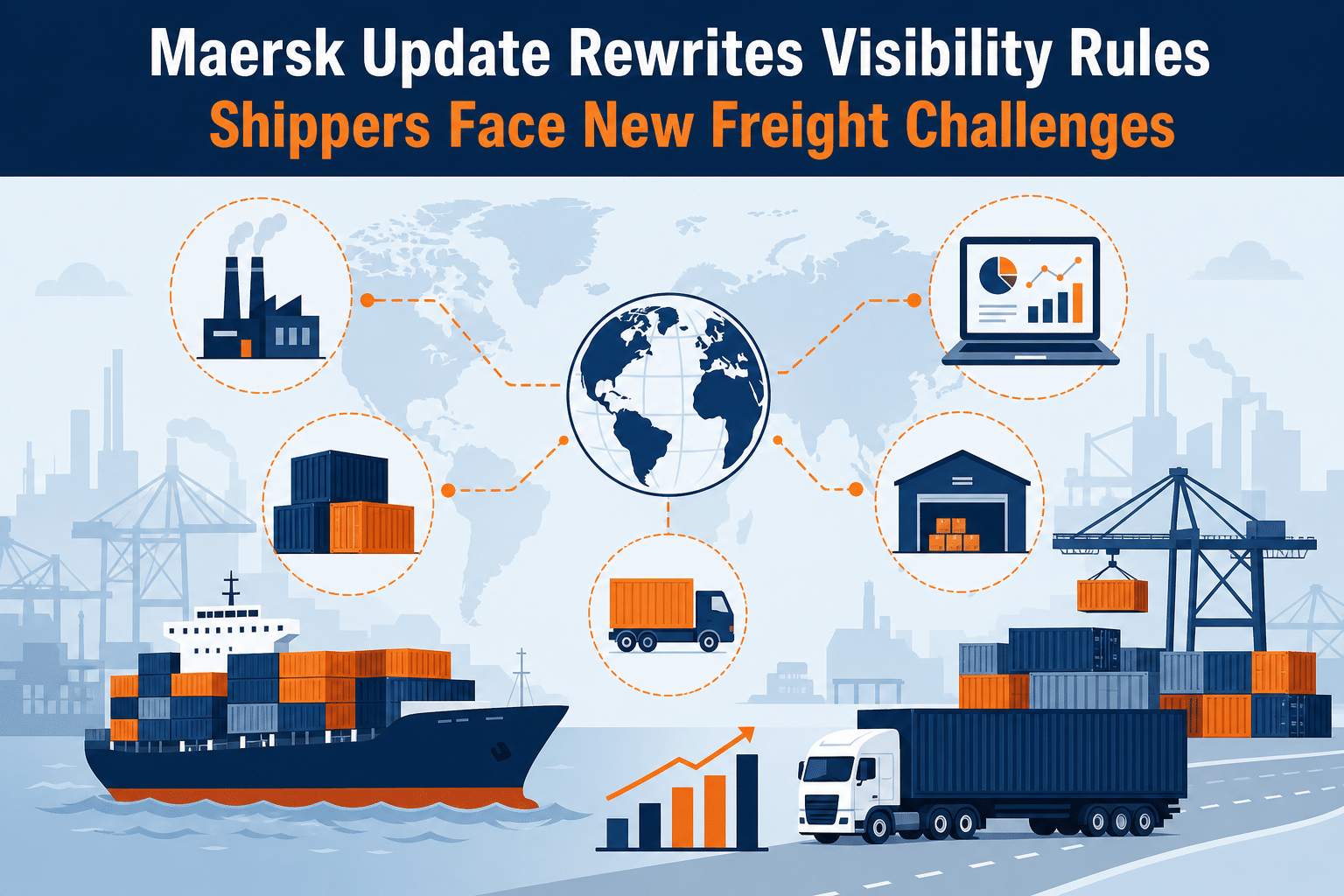
Freight visibility implications of Maersk Latin America Market Update — July 2026
The Maersk Latin America Market Update for July 2026 reports 62.4% global schedule reliability in April and average delays above five days.
For you, freight visibility must go beyond container tracking. It needs to cover ETA accuracy, port dwell time, inland handovers, reefer conditions and weather risk across Latin America.
At Logistics Concepts, we read the update as a signal to connect ocean, road and intermodal data into one operational view. That means alerts, normalized milestones and usable KPIs.
The priority is clear: reduce blind spots before they create missed delivery slots, detention and demurrage, stock disruption or customer service issues.
Visibility signals from the July 2026 update and their operational impact
The July 2026 Latin America market update shows that freight visibility needs to cover ocean, port, inland and climate risk. We no longer treat visibility as track and trace only. For you, it supports planning, exception management and cost control across regional flows.
| Visibility fact | Operational implication for Latin America | Control point |
|---|---|---|
| 62.4% global schedule reliability in April 2026 | Buffer planning remains needed on Latin America, Transpacific and Transatlantic lanes. | Use estimated ETA, ETD, shipment milestones and visibility KPIs. |
| Average global delays were over 5 days | Inventory, customs clearance and delivery appointments need dynamic replanning. | Connect TMS, EDI, tracking APIs, webhooks and control tower alerts. |
| The update reports an El Niño probability of 80% from June to August, then over 90% | Weather risk may affect Andean infrastructure, Central America, Caribbean flows and agricultural exports. | Use predictive analysis, reefer monitoring, onboard IoT and temperature sensors. |
| Port waiting times mostly 1 to 3 days, with Itapoá and Rio Grande at 4 to 7 days | Port performance is stable overall, but dwell time and transshipment exposure still need monitoring. | Track Santos, Callao, Buenaventura, Cartagena, Balboa and Montevideo through vessel tracking and AIS. |
We see these signals as a need for end to end visibility and timely operational data. You need container status by container number, electronic bill of lading, proof of delivery, vessel tracking and port events. Predictive ETA and exception management help reduce missed slots, detention and demurrage.
Maersk visibility features compared with market alternatives
Freight visibility across Latin America depends less on one platform than on data quality, carrier coverage and exception workflows. The July 2026 update points to continued volatility, with 62.4% schedule reliability and average delays above 5 days in April 2026.
| Assessment area | Maersk visibility features | Competitor benchmark | Operational limits to verify |
|---|---|---|---|
| Data reliability | Carrier native track and trace, container status, ETD, estimated ETA and vessel tracking. | Forwarders, NVOCCs and visibility providers often combine AIS, EDI and terminal events. | Check event latency, shipment milestones, data normalization and tracking API quality. |
| Predictive analytics | ETA forecasting, predictive analysis and exception alerts support planning on Latin America to North America routes. | Specialist platforms may add predictive ETA, dwell time analytics and carrier performance benchmarks. | Validate ETA accuracy rate, blank sailing detection and transshipment updates. |
| Coverage | Ocean visibility covers Latin American ports such as Santos, Callao, Cartagena and Manzanillo, Panama. | 3PL and 4PL control tower models may extend to trucking, intermodal moves, customs clearance and proof of delivery. | Assess inland connectivity, drayage capacity, gate appointments and final mile visibility. |
| Special cargo | Reefer monitoring can support cold chain flows, including perishables and agricultural exports. | IoT providers may add temperature sensors, GPS sensors, NB IoT, LoRaWAN and RFID. | Confirm temperature and humidity records, alerting SLA and data access for claims. |
Priorities for shippers: TMS integration, alerting, KPIs and contracting
To secure freight visibility and end to end visibility, we connect your TMS, WMS and ERP to a visibility platform through tracking APIs, webhooks and EDI. We normalize ETD, estimated ETA, container status and shipment milestones before adding predictive ETA or predictive analysis.
| Priority | Action | Control point |
|---|---|---|
| Integration | Use SMDG messages for ocean events, EDI where required, and XML or JSON for API exchange. Use GS1 EPCIS only when item level event tracking is needed. | Data quality, master data management and API interoperability. |
| Alerting | Set proactive notifications for blank sailings, transshipment changes, dwell time and port congestion. | Exception management in real time. |
| KPIs | Track schedule reliability, on time delivery, ETA accuracy rate and exception rate. | Visibility KPIs by lane, carrier and port. |
| Contracting | Add visibility SLA, alerting SLA, proof of delivery, eBL, HBL and MBL clauses. | Data latency, carrier response time and detention and demurrage exposure. |
For Latin America to North America, Transpacific and Transatlantic routes, we configure the control tower by corridor. Include Panama Canal transits, Latin American ports, vessel tracking, AIS, reefer monitoring, temperature sensors, humidity sensors and GPS sensors where cargo risk requires them.